— AI Product · PM-minded Design · 2024
Repartee AI
Designing for trust when the AI doesn't always tell the truth.
Repartee AI is a startup building a customizable AI assistant platform focused on minimizing hallucination in LLM responses. I served as the product manager overseeing user experience, partnering closely with an engineering-focused PM to define and execute the product vision. We reported directly to the CEO and led cross-functional collaboration between engineering and design.
Project Timeline
8 Month
Jan -Sep 2024
Team
1 UX-focused PM (me)
1 Dev-focused PM
1 Product Owner
3 Developers
2 AI/ML researchers
1 UI Designer
My Role
Product Design
Research
R&D
Tools
Figma
Notion
Lark
Google Sheets
Slack
“We built an AI that could talk to documents. But what if it told you the wrong thing — confidently?”
Goal
Make AI uncertainty visible, not hidden.
Translate probability → plain language.
Bridge engineer dashboards and business decision tools.
Solution
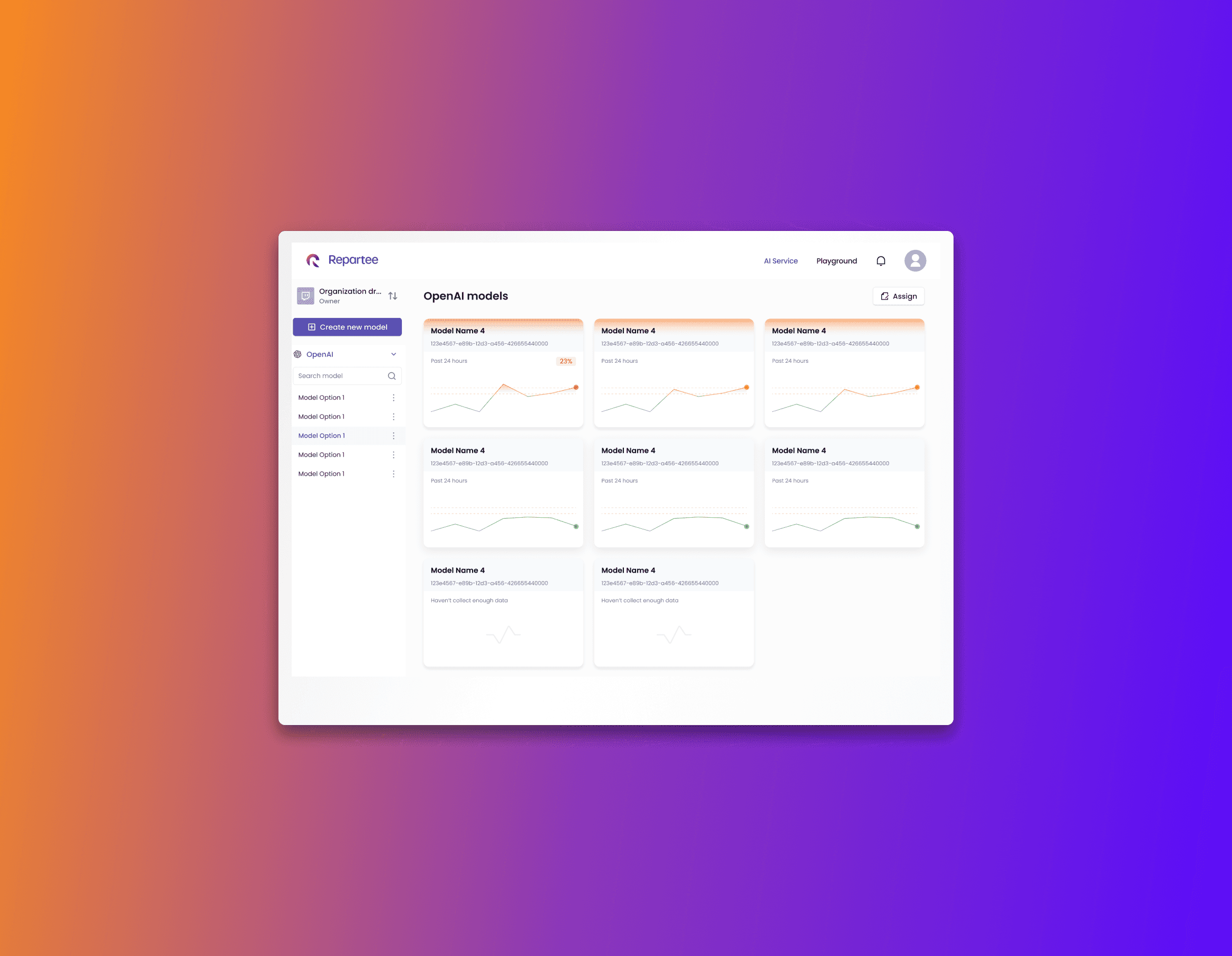
A Model Detection Dashboard
The Problem
LLM hallucination isn't a bug. It's a trust crisis.
In 2024, enterprises were starting to seriously adopt LLMs — but every team we talked to had the same frustration: the AI sounded confident even when it was wrong. There was no signal, no way to tell a reliable output from a fabricated one.
ReparteeAI's core thesis was to fix exactly this: build a platform that could surface hallucinations inline, so users could verify AI outputs without leaving the workflow.
The real problem wasn't that AI made mistakes. It's that users couldn't tell when it was making them.
Internally, we had our own version of this problem. The company's direction shifted three times in 8 months — AI platform, then ML ops, then Web3 infrastructure. As the UX-focused PM, my job wasn't just to design. It was to keep the product moving when the roadmap kept changing underneath us.
HOW MIGHT WE
How might we reduce uncertainty in AI-generated outputs so users can confidently review, verify, and act — without leaving their workflow?
Problem
When Teams Can’t Trust Their Own Models
Pain Point 1
No visibility into how reliable model predictions are
Pain Point 2
PMs and execs can’t make data-backed decisions
Pain Point 3
ML engineers overloaded verifying results manually
Target User
When Teams Can’t Trust Their Own Models
Pain Point 1
No visibility into how reliable model predictions are
Pain Point 2
PMs and execs can’t make data-backed decisions
Pain Point 3
ML engineers overloaded verifying results manually
Research
Activities
Competitive Analysis of 7+ GenAI tools: LangChain, Claude, Pinecone, RunPod
Stakeholder Interviews: surfaced confusion around hallucination signals
Workflow Mapping: mapped end-to-end user journey in enterprise RAG setups
Insight
Users wanted actionable transparency — not technical complexity.
Product Strategy & UX Architecture
My Contributions
Designed an async documentation system to streamline PM–engineer–design collaboration (reduced meetings by 50%)
Co-led roadmap prioritization: positioned hallucination detection as our core product wedge
Led the Landing Page V2 redesign to clarify product messaging for both developers and investors
Key UX Flows
Hallucination flagging & explanation in chat-style UI
Confidence score thresholds + inline source matching
Dashboard overview: track failure rates across queries
Outcomes & Impact
Metric
Impact
Enterprise user adoption
⬆️ 35%
Retention rate (4 weeks)
⬆️ 20%
Dev/design sync efficiency
⬇️ 50% sync meeting time
Investor narrative alignment
✅ Helped close product-market fit story
Reflection
What I learned
How to make LLM risks legible through good UX
Balancing vision + feedback + feasibility in ambiguous startup environments
Design is not just about screens — it’s also about the story you tell
What If I Had More Time?
A/B Test the hallucination alert UI (confidence clarity, placement)
Design a “mitigation recommendation” layer (e.g., suggest alternate phrasing)
Add user feedback loop on flagged hallucinations to train detection engine
Mobile support: Quick preview of dashboards and flagged queries on the go
Analytics Drill-down UI: Click to see per-query or per-user patterns
Takeaways
Hallucination detection isn’t just a backend feature — it’s a trust layer. And trust is a design problem.
This project helped me sharpen my ability to:
Communicate complex AI problems to users and stakeholders
Build clarity-first products in the B2B AI space
Translate abstract risks into usable, trustworthy interfaces
Thank you.